



What Is the Cybex R Series Lower Body Arc Trainer?
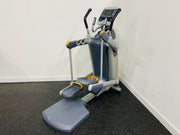
The Cybex R Series Lower Body Arc Trainer is a commercial cardio machine designed to place the training emphasis on the legs. Its lower-body configuration uses stationary arms, allowing users to concentrate on leg drive, conditioning and power without coordinating moving upper-body handles. The exact submodel and console configuration of a particular used unit should be confirmed from the current product listing and machine label.
Cybex product literature identifies the glutes, quadriceps, hamstrings and calves as the primary lower-body areas targeted by the Arc Trainer’s design. This gives a commercial cardio floor a leg-focused option alongside treadmills, bikes and full-body elliptical-style equipment.
General model specifications
The Uplift listing reports 21 incline levels, contact heart rate handles, dimensions of 77 inches long by 33 inches wide by 60.5 inches high, and a maximum user weight of 400 pounds, or 181 kilograms. It lists power requirements of either 120V, 20A or 230V, 10A depending on country, with a dedicated outlet and circuit breaker.
Cybex documentation describes a 24-inch stride length and separate lower-body and total-body configurations. These are general model or product-family details. They do not confirm that every console, accessory or feature is present and functional on a specific pre-owned machine.
Training Benefits and Programming Options
The stationary-arm design is useful when the legs are the primary focus of a workout. Users can work through the Arc Trainer motion while using the handles for support, and the incline system provides multiple ways to vary the session. A manageable setting can support steady cardio, while structured intervals can create a more demanding conditioning workout.
Manufacturer documentation identifies strength intervals, cardio intervals, wave-style endurance intervals, heart-rate-control workouts and constant-power workouts among the available programming approaches. The best setting depends on the user’s experience, objective and ability; a higher incline or resistance level is not automatically the right choice.
How incline changes the session
The 21 incline levels create workout variety without requiring another machine. A lower setting may help a new user learn the stride and establish a sustainable pace. Higher settings can increase the challenge and change how effort is distributed across the legs. Coaches should monitor technique, perceived exertion and recovery rather than prescribing intensity from incline alone.
The Arc Trainer is a cardio and conditioning tool, not a replacement for controlled resistance training when the goal is maximal strength or muscle hypertrophy. It can complement a strength program with lower-body conditioning, but it does not provide the same stimulus as dedicated resistance exercises.
Safe, straightforward operation
Cybex operating guidance states that the pedals begin moving when weight is placed on them. Users should mount carefully, using the frame or stationary handles for support as needed. The machine is not free-wheeling, so the foot plates should stop completely before dismounting.
A sensible introduction is to begin with a low incline and manageable resistance, learn the arc motion and increase duration or intensity gradually. Users should stop for faintness, dizziness, pain or unusual shortness of breath. Fitness professionals should adapt instruction to the individual and follow appropriate medical guidance.
Design Advantages for Commercial Fitness Spaces
A lower-body Arc Trainer can add variety to a commercial cardio floor while serving members who specifically want to train their legs. Its stationary-arm layout makes the purpose clear: users can focus on lower-body effort without coordinating moving upper-body handles. This may suit performance-oriented facilities, interval-training spaces and gyms seeking an alternative to treadmills or standard ellipticals.
The Uplift listing reports internet connectivity for equipment data, exerciser insights, preventive maintenance alerts and remote monitoring. These are listed capabilities, not proof that the particular used unit has functioning networking hardware or an active connected service. Facility managers should verify the console and connectivity configuration before relying on those functions.
Planning the installation
The reported footprint is substantial. Planners should account for 77 inches of length, 33 inches of width and 60.5 inches of height, along with safe access around the machine and applicable installation guidance.
Power planning also matters. The listing identifies either 120V, 20A or 230V, 10A depending on country and specifies a dedicated outlet and circuit breaker. A qualified installer should confirm the local electrical setup, machine data plate and included power cord before commissioning.
Who can benefit from it?
The machine may suit commercial gym members, personal-training clients, athletes and home users seeking lower-body cardio or interval conditioning. It can also help facilities provide a dedicated leg-focused option alongside other cardio equipment.
It is less suitable for buyers seeking compact cardio equipment, a purely upper-body workout or a substitute for progressive strength equipment. Its dimensions, electrical requirements and commercial design should be considered before selecting it for a small room or lightly equipped home gym.
Why Consider Pre-Owned Commercial Equipment?
Pre-owned commercial equipment can give a facility access to an established machine design without requiring every purchase to be new. A used commercial unit may appeal to buyers who value a substantial construction profile, multiple workout settings and equipment originally designed for demanding gym environments.
However, the value of pre-owned equipment depends on the specific unit, not only the model name. The current product listing remains authoritative for that item’s condition, included components and applicable terms. General Cybex specifications do not confirm the condition of bearings, belts, pulleys, linkage joints, incline motor, foot plates, console, heart rate sensors, battery, generator or networking system.
What to inspect on the current listing
Request a clear photo of the serial or model label, which Cybex service documentation identifies on the lower crossbar. Ask for a console photo and confirm the configuration. Do not assume the precise submodel from the product title alone.
A demonstration video should show startup, full incline travel, several resistance levels, both pedals under load, console operation and the contact heart rate handles. Listen for unusual noise, check for excessive pedal play and watch for incline hesitation, error codes or display problems. Request written details of refurbishment work rather than relying only on the word refurbished.
Confirm the purchase terms
Verify the actual electrical requirement, included cord, delivery method and whether placement is included. Confirm the applicable warranty, labor coverage and return policy directly with the seller; these terms should not be inferred from manufacturer documentation.
An in-person inspection can be useful where practical, allowing a buyer or technician to assess movement, noise, cosmetic wear and console operation. If a replacement unit returns to the listing, reassess that current listing rather than relying on earlier assumptions.
Limitations to Understand Before Buying
The Cybex R Series Lower Body Arc Trainer is a specialized, substantial cardio machine. Its lower-body focus benefits some programs but limits users seeking integrated upper-body movement. It also requires adequate floor space and suitable electrical provision, while its commercial systems may be more complex than those on basic home cardio equipment.
The used unit’s exact submodel, console, electrical configuration, refurbishment work, warranty, networking functionality and mechanical condition are not established by general product-family information. Confirm each point from the current listing and seller documentation. Strong model-level capabilities do not eliminate the need to inspect wear items and electronics.
Overall, the Arc Trainer is most compelling when a facility needs leg-focused cardio with adjustable incline and interval potential. Evaluate it as both a training tool and a used commercial asset: match the motion to users, then verify the machine, installation requirements and purchase terms before acquisition.
Frequently asked questions
What muscles does the Cybex R Series Lower Body Arc Trainer target?
Cybex identifies the glutes, quadriceps, hamstrings and calves. Actual emphasis varies with technique, incline, resistance and workout structure.
Is the Cybex R Series Lower Body Arc Trainer suitable for HIIT?
Yes. The supplied product information and manufacturer documentation identify interval workouts as intended uses. Build intensity progressively and choose settings appropriate to the user.
What is the maximum user weight listed for this Arc Trainer?
The Uplift listing reports 400 pounds, or 181 kilograms. Confirm the machine data plate and current listing before use.
Does the lower-body Arc Trainer have moving arms?
No. The listed configuration has stationary arms. Cybex documents a separate total-body configuration with moving arms, which should not be assumed for this unit.
What should I inspect on a used Cybex Arc Trainer?
Inspect the model label, console, incline, resistance, pedals, belts, bearings, joints, heart rate handles, error codes and networking. Also request written details of refurbishment work.
Can an Arc Trainer replace strength training?
No. It can complement strength programming with conditioning but cannot replace controlled resistance training for maximal strength or hypertrophy.
Explore Uplift Equipment

Cybex R Series Lower Body Arc Trainer Commercial / Home
See this equipment’s current price, condition and availability.
View Cybex R Series Lower Body Arc Trainer Commercial / Home and check current availability.
Cybex R Series Lower Body Arc Trainer: Commercial Fitness Guide
How to Use the Cybex R Series Lower Body Arc Trainer