
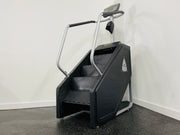
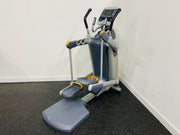
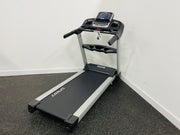
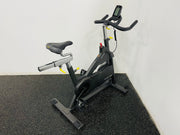



What the Life Fitness 95FS FlexStrider Trains
The Life Fitness 95FS FlexStrider is a commercial variable-stride cardio machine. Its pedals guide a continuous stepping motion while the user can adjust stride length and resistance. The model has a maximum stride length of 36 inches and 26 resistance levels, allowing shorter controlled movement or a longer stride when that feels stable and natural.
The primary training demand is on the lower body. The glutes, quadriceps, hamstrings, and calves contribute to the repeated stepping action. The trunk helps maintain an upright position, while the arms may contribute when the moving handles are used. The emphasis changes with stride length, resistance, cadence, posture, and handle use.
These muscle descriptions explain the movement pattern rather than guaranteeing a particular result. Available documentation does not establish that the 95FS is inherently low impact, appropriate for rehabilitation, or safer for a specific medical condition.
Use Stride and Resistance Separately
Resistance can be changed independently of pedaling speed. Maintain a steady cadence while increasing resistance, or alter stride length while keeping resistance manageable.
The 36-inch stride is the model maximum, not a required training setting. Begin with a shorter stride and lengthen it gradually only if you can keep your feet planted and torso controlled. For general aerobic work, the talk test is useful: moderate intensity generally allows conversation but not singing.
Set Up the FlexStrider Before Training
Place the machine on a stable, level surface and leave room for the moving pedal levers. The FlexStrider manual calls for approximately 24 inches of clearance around the machine, with particular attention to the front. For delivery and room planning, the manual lists approximately 104 inches long by 34 inches wide by 68 inches high and 589 pounds. The Uplift listing gives slightly different dimensions and weight, so confirm the exact unit before delivery.
Check that the pedals are clean, intact, and firmly attached. Confirm that the machine is stable and the rear levelers contact the floor. If the console, power cable, hand sensors, or controls show an error or behave inconsistently, stop and have the equipment assessed.
Step onto the pedals carefully, holding a fixed support if needed. Select a short stride and low resistance for the first minutes. Adjust the console, water, and reading material before increasing intensity so you do not reach or twist while the pedals are moving.
Inspection Checklist for a Pre-Owned Unit
General 95FS specifications do not confirm the condition of a particular used machine. Inspect the current product listing and ask the seller to demonstrate smooth stride adjustment, several resistance levels, console operation, hand-sensor function, pedal attachments, leveler stability, and the absence of unusual grinding, clicking, knocking, belt squeal, or excessive side-to-side play.
Also confirm the serial number, exact console configuration, included power cable, delivery requirements, and written terms applying specifically to the pre-owned unit. Operating hours, prior use, component wear, warranty coverage, and the pictured unit’s condition should not be assumed from the model name. The current product listing remains authoritative if a replacement unit is returned.
Proper FlexStrider Form and Exercise Steps
Use this sequence for a controlled session: stand tall with both feet secure and weight balanced; hold the moving handles lightly if you want upper-body involvement; and begin with a short stride and easy resistance. Establish a smooth rhythm before adjusting anything.
Keep your head up, shoulders relaxed, and ribs stacked over your pelvis. Maintain a quiet torso rather than bouncing, twisting, or collapsing forward. Drive the pedals through a comfortable range while keeping your knees aligned with your feet. Do not force the maximum stride length.
Change one variable at a time. Increase resistance gradually or lengthen the stride slightly, then reassess control and breathing. Before stopping, reduce resistance and stride, allow the pedals to slow fully, and step off carefully. Good form is repeatable form; if the hips rock, knees drift, or you hang on the handles, shorten the stride.
Common Mistakes to Correct
Using the longest stride immediately can turn smooth cardio into an awkward reach. Start shorter and progress by comfort and control. High resistance combined with a fast cadence can encourage shortened, jerky steps and excessive upper-body effort.
Avoid locking the knees, leaning body weight into the handles, staring down at the pedals, or gripping so tightly that the shoulders rise. Do not make large stride and resistance changes simultaneously. In shared facilities, keep loose clothing, towels, and accessories away from moving parts.
Sets, Reps, and Workout Programming
Cardio machines are usually programmed by time, intensity, and intervals rather than traditional strength-training repetitions. A beginner can start with 5 to 10 minutes at an easy, controlled effort, including the warm-up, then build toward 15 to 20 minutes before emphasizing harder resistance or a longer stride.
A practical steady-state session is 5 minutes easy, 10 to 20 minutes at a moderate talk-test intensity, and 3 to 5 minutes gradually easier. Perform it two or three times weekly initially, leaving recovery between challenging sessions. These are general coaching options, not a machine-specific prescription or medical program.
For intervals, use 4 to 6 rounds of 30 to 60 seconds at a purposeful but controlled effort followed by 1 to 2 minutes easy. Keep the stride moderate if a longer stride interferes with posture. Progress one factor at a time: add minutes, one interval, or a small resistance increase.
CDC guidance recommends at least 150 minutes of moderate-intensity aerobic activity weekly for general adult health, plus muscle-strengthening activity on at least two days. Use that as broad planning guidance and adapt the schedule to the individual, facility, and training objective.
Beginner and Advanced Options
Beginners should prioritize familiarization, balance, smooth pedal travel, and consistent breathing. More experienced users can combine moderate and long strides, use resistance intervals, or extend continuous sessions. Advanced training still requires no forced range, no loss of balance, and no heavy dependence on the handles.
Complementary Exercises and Safety Practices
Pair the FlexStrider with strength work that it does not provide as its primary focus, such as a squat or leg-press pattern, hip hinge, horizontal push, row, and trunk-control exercise. Use a short FlexStrider warm-up before lifting when technique remains fresh, or separate cardio and resistance work when fatigue could affect form.
Vary the cardio stimulus across the week. Use steady moderate sessions for aerobic volume and occasional intervals for a more demanding workout. Avoid making every session a maximum-resistance or maximum-stride effort; controlled progression is easier to manage.
Stop if the machine becomes unstable, produces an unfamiliar mechanical sound, displays an error, or the user cannot maintain control. This is general fitness information, not medical advice. Anyone with health concerns, exercise symptoms, or uncertainty about suitable intensity should seek individualized guidance from an appropriately qualified professional.
How to Evaluate the Used Life Fitness 95FS Listing
The listed dimensions, resistance levels, stride range, user capacity, and features describe the general 95FS model. They do not promise that every feature is present or functional on a particular pre-owned unit. Review the current listing carefully and ask for confirmation of the exact console, serial number, stride adjustment, resistance changes, sensors, pedal condition, levelers, power supply, and any applicable return or warranty terms.
The seller’s condition description should be treated as a listing statement rather than an independently verified inspection result. Ask for an operating demonstration if possible, paying attention to smooth pedal travel, unusual noise, side-to-side play, console errors, and stability. Confirm the larger manual dimensions for planning until the exact configuration is verified.
Frequently asked questions
What muscles does the Life Fitness 95FS FlexStrider work?
It primarily trains the glutes, quadriceps, hamstrings, and calves. The trunk supports posture, while the arms may contribute when the moving handles are used.
What stride length should a beginner use?
Start with a short stride that allows smooth, stable movement. Increase length gradually only when posture, knee tracking, and pedal control remain consistent.
How long should a FlexStrider workout be?
Start with 5 to 10 easy minutes and build toward 15 to 20 minutes. A practical session can include an easy warm-up, moderate work, and a gradual cooldown.
Should I increase resistance or stride length first?
Change one variable at a time. Make a small resistance increase at a controlled cadence, or lengthen the stride slightly while keeping resistance manageable.
Does a used 95FS have the model’s listed condition and features?
No. Specifications describe the general model, not a particular used unit. Inspect the current listing and confirm console function, stride adjustment, resistance, pedals, sensors, levelers, noise, power, and applicable terms.
Explore Uplift Equipment

View Life Fitness 95FS FlexStrider and check current availability.
Life Fitness 95FS FlexStrider: Commercial Cardio Equipment Guide
Life Fitness 95FS FlexStrider Benefits: Is This Variable-Stride Machine Right for Your Gym?