



What the Star Trac 8-RDE Elliptical Trains
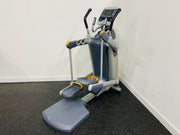
The Star Trac 8-RDE is a commercial rear-drive elliptical intended for steady cardio and higher-intensity sessions. Its pedal motion repeatedly involves the hips, knees, and ankles, while the moving arms can add upper-body work. The trunk mainly supports posture and control rather than driving the exercise.
The listing identifies this unit as self-powered with an LED console. Manufacturer information describes the 8RDE as having an 18-inch stride and 20 resistance levels, but configurations and production revisions may differ. For a pre-owned machine, confirm details against the current listing and the identification label.
Muscles worked during a standard stride
The legs and hips do most of the work. The quadriceps assist knee extension, while the glutes and hamstrings contribute to hip extension. The calves assist as the foot moves through the stride. Actively pushing and pulling the moving handles can involve the chest, shoulders, back, and arms.
Resistance, pace, posture, and handle use change the emphasis. Continuous moderate work is primarily cardiovascular. Higher resistance can make strides more demanding, but it does not replace dedicated strength training.
Star Trac 8-RDE Setup Before You Start
Place the elliptical on a stable, level surface with clearance for the machine and the user’s movement. The supplied listing gives this used item’s dimensions as 35 inches wide, 86 inches long, and 73 inches high. Research found conflicting documentation showing 35 or 36 inches of width and 395 or 320 pounds of machine weight. Confirm the actual identification plate before planning transport, flooring, or installation.
Inspect the pedals, moving arms, frame, belt area, console, visible hardware, and pedal joints. Look for loose, damaged, unusually noisy, or rough components. Do not assume a general model specification describes the current condition of a pre-owned unit.
Mounting and console setup
Stand beside the machine, hold a stable handle, and step onto the lowest pedal only when the pedals are stopped. Secure both feet, select a low resistance, and begin at a controlled pace. Adjust the console for the available time, resistance, and workout feedback.
The manufacturer’s stated maximum user weight for the 8RDE is 350 pounds. Confirm that the actual unit carries the applicable specification, particularly if its label or configuration differs from published materials.
Find a balanced stance
Keep your feet fully inside the pedals, with knees tracking generally in line with the toes. Stand tall with a neutral head, relaxed shoulders, and ribs stacked over the hips. Use a light grip on the moving or stationary handles instead of hanging your body weight on them.
Allow a natural heel-to-toe motion. Choose a resistance and pace that let you control the pedals without bouncing, twisting, or reaching for momentum.
Proper Elliptical Form and Exercise Steps
Use this sequence for a basic workout: mount only after the pedals stop; place both feet securely in the pedals; begin with easy strides at low resistance; maintain an upright torso and relaxed shoulders; and drive smoothly through the available stride. If using the moving arms, coordinate a comfortable push-pull pattern without shrugging or leaning excessively.
Increase only one variable at a time: duration, pace, or resistance. At the end, reduce your pace gradually. The owner’s manual notes that the machine does not have a freewheel, so do not stop the pedals abruptly. Wait until they stop completely before dismounting.
A quiet, repeatable rhythm is a better form target than chasing speed. Stop and arrange an inspection if the machine develops unusual squeaking, grinding, vibration, or inconsistent resistance.
Common elliptical mistakes
Leaning heavily on the handles reduces the work required from the legs and can compromise posture. Other common errors include locking the knees, shortening the stride, letting the knees collapse inward, gripping too tightly, or looking down at the console continuously.
Excessive resistance may cause rocking, straining, or an uncontrolled slowdown. Reduce the pace or resistance when alignment deteriorates, and avoid changing several training variables at once.
Elliptical Workouts for Beginners and Advanced Users
Elliptical training is usually prescribed by time, effort, resistance, or intervals rather than conventional sets and repetitions. The following formats are starting points, not guarantees of a particular result. Beginners should prioritize consistency, control, and comfortable breathing.
Beginner steady-state session
Start with 5 to 10 minutes at an easy-to-moderate effort, including a gradual warm-up. Use a resistance that allows smooth strides and conversation. When the duration feels manageable, add a few minutes to later sessions while maintaining posture and control.
Two or three sessions per week can provide practice with the machine. Federal guidance recommends that inactive adults begin with small amounts and build gradually toward regular activity. The general adult target is 150 to 300 minutes of moderate-intensity aerobic activity weekly, alongside muscle-strengthening activity on at least two days.
Intermediate interval session
After establishing steady movement, try a warm-up followed by 6 to 10 rounds of 30 to 60 seconds at a challenging but controlled pace, with 1 to 2 minutes of easy recovery after each round. Finish with several easy minutes.
Use the talk test: moderate effort generally allows conversation, while vigorous effort permits only a few words. Keep the resistance low enough to maintain alignment and slow down safely.
Appropriate advanced progression
Experienced users can progress one variable at a time by extending work intervals, shortening recoveries, increasing resistance, or adding total session time. Alternate harder sessions with easier aerobic work rather than making every workout maximal.
Complement elliptical conditioning with strength exercises such as squats, hinges, presses, rows, and calf raises. These movements address patterns that repeated elliptical motion does not fully train.
Safety and Inspection Guidance for a Pre-Owned 8-RDE
Before regular facility use, inspect the actual used unit. Check the frame for damage, confirm labels are intact, test console feedback, and evaluate whether the pedals, arms, belt, bearings, and resistance changes operate smoothly and quietly. Request a functional demonstration or operating video when the current listing does not show these details.
The listing describes a silver, pre-owned LED-console unit, but its actual hours, service history, replacement parts, cosmetic condition, warranty coverage, and performance cannot be established from general model specifications. Treat these as items to verify on the current product listing or with the seller. The listing remains authoritative if a replacement unit returns.
Stop if you experience dizziness, unusual shortness of breath, chest discomfort, significant joint pain, or loss of control. This is general equipment guidance, not medical advice; obtain appropriate professional guidance for health-related concerns.
Complementary exercises for a complete program
The elliptical provides repeated locomotion and aerobic conditioning. A broader program can combine two or three elliptical sessions with strength work for the legs, hips, pushing muscles, pulling muscles, and trunk. Mobility work and easy walking can provide lower-intensity movement between harder sessions.
For a facility, coaching should emphasize machine familiarity, conservative progression, and clear stopping rules. Record duration, resistance, and perceived effort so users can progress without guessing.
Frequently asked questions
What muscles does the Star Trac 8-RDE elliptical work?
It primarily trains the quadriceps, glutes, hamstrings, and calves. Moving handles add arm, shoulder, chest, and back involvement while the trunk supports posture.
How long should a beginner use the Star Trac 8-RDE?
Begin with 5 to 10 minutes at an easy-to-moderate effort, then add time gradually when smooth strides and upright posture remain consistent.
What resistance should I use on an elliptical?
Use the lowest resistance that permits smooth control, increasing gradually. Reduce resistance or pace if you rock, bounce, strain, or cannot slow comfortably.
Should I use the moving handles?
Use them for additional upper-body involvement with a light, coordinated grip. Stationary handles are suitable while learning or when extra balance is needed.
How do I stop the 8-RDE safely?
Reduce pace gradually because the manual states that it has no freewheel. Wait until the pedals stop completely before dismounting.
What should I inspect on a used Star Trac 8-RDE?
Inspect the frame, pedals, joints, arms, belt area, console, labels, and hardware. Test resistance and listen for noise or vibration. Confirm the machine label because published dimensions and weight differ.
Explore Uplift Equipment

Star Trac 8-RDE Elliptical Trainer Silver
See this equipment’s current price, condition and availability.
View Star Trac 8-RDE Elliptical Trainer Silver and check current availability.
Star Trac 8-RDE Elliptical Trainer: Commercial Fitness Equipment Guide
Star Trac 8-RDE Elliptical Trainer: Commercial Benefits and Buying Guide