



What the Star Trac E-CT Cross Trainer Works
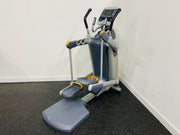
The Star Trac E-CT is a commercial elliptical, or cross trainer, that combines continuous leg movement with moving-handle work. Its guided pedal path lets users focus on posture, breathing and consistent effort rather than balancing during each stride.
The pedals primarily involve the quadriceps, hamstrings, glutes and calves. Actively pushing and pulling the handles also involves the chest, back, shoulders and arms, while the trunk helps control the torso. Treat the E-CT mainly as cardio equipment, not a replacement for dedicated strength machines.
Historical E-Series materials document SoftTrac shock-absorbing pedals, resistance levels from 1 through 20 and an approximately 7-inch step-up height. The supplied Uplift listing states a 350-pound maximum user weight; verify the current listing and operating information before use.
Set Up Before Your First Stride
Place the cross trainer on a stable surface with clearance for the pedals and moving arms. Step onto the stationary platform carefully while holding a fixed support point, not a moving handle. Center both feet in the pedals before taking the moving handles.
Stand tall with your head over your torso and shoulders relaxed. Keep a comfortable knee bend, and wear footwear and clothing that cannot catch on the machine. Start with low resistance and an easy pace while checking the pedals, arms, console and resistance response.
The E-Series manual describes Quick Start, preset programs, fan control and heart-rate display functions. On a used machine, ask the seller about the actual console, sensors, pedals and service history. Model specifications do not establish the condition of a particular unit.
Important Listing Details to Verify
Historical E-CT documentation gives assembled dimensions of approximately 30 by 76 by 71.5 to 72 inches and a factory weight of about 447 pounds. The supplied Uplift listing states 27 by 70 by 68 inches and 350 pounds. Treat those measurements as unconfirmed until Uplift verifies the current unit’s assembled dimensions and shipping weight for doorway, flooring, stair and delivery planning.
Proper Star Trac E-CT Form
Begin pedaling smoothly rather than forcing the first cycles. Keep the entire foot supported, distribute pressure across the foot and let the knees track in line with the feet. A quiet, continuous stride is preferable to jerking or using momentum.
Keep your spine neutral and ribs stacked over your pelvis. Avoid hunching over the console or leaning heavily on the handles. Use a light grip for balance; when using the moving arms, push and pull without shrugging the shoulders or twisting the torso.
Choose resistance that allows full, controlled movement. Heart-rate monitoring can help gauge effort, but the E-Series manual warns that heart-rate systems may be inaccurate, so treat the display as one reference rather than a precise measurement.
Exercise Steps
1. Step onto the stationary platform and place both feet securely in the pedals.
2. Select Quick Start for manual control or choose a suitable preset program.
3. Begin at an easy pace and low resistance.
4. Maintain an upright torso, relaxed shoulders and aligned knees.
5. Adjust pace or resistance gradually while keeping the stride smooth.
6. Reduce effort for a cool-down and wait for the pedals to stop before stepping off.
Workout Plans for Beginners and Experienced Users
Beginners should prioritize repeatable technique. Start with 10 to 15 minutes at an easy-to-moderate effort, using manual mode and low resistance. If control remains consistent, add a few minutes in later sessions, gradually building toward 20 to 30 minutes.
For a steady session, warm up gradually, maintain a moderate resistance that does not cause leaning or excessive gripping, then lower the pace and resistance before dismounting. The documented 20 levels allow adjustments, but the appropriate setting depends on the user’s current control and conditioning.
More experienced users can alternate a controlled harder segment with an easier recovery for several rounds. Preset programs are another option when the user understands resistance changes and can maintain form. Increase duration, resistance or pace one variable at a time.
These are general programming examples, not individualized medical or exercise advice. Users returning after extended inactivity or exercising with a known health condition should follow the manual and obtain appropriate professional guidance.
Common Mistakes and How to Correct Them
Leaning on the console can place the torso in a poor position. Stand taller, lighten your grip and reduce resistance until you can control the stride without relying on your arms.
Avoid riding only on the toes, locking the knees, bouncing the shoulders or twisting the hips. Keep the feet supported and use an even push. If the pedals slow abruptly or the stride becomes choppy, lower the resistance.
Do not chase a heart-rate number if the sensor reading seems inconsistent. Stop for dizziness, faintness, chest discomfort, unusual shortness of breath or other concerning symptoms, as advised in the manual.
Complementary Exercises and Used-Equipment Checks
The E-CT can provide cardio alongside strength exercises it does not fully replace. A commercial-gym session might combine cross-trainer work with a controlled squat or leg-press pattern, a row or pulldown, an upper-body press and a controlled plank. Select movements and loads that allow consistent technique.
Do not assume a used machine performs like a new one because its model specifications are documented. Request a startup video showing the console, resistance changes, pedals, moving arms, fan and heart-rate functions. Check for unusual noise, looseness, vibration or inconsistent resistance.
Ask for the model and serial label, confirmation that the unit is specifically an E-CT rather than an E-CTe or newer CT model, and details about inspection, replacement parts, warranty and returns. Pre-wiring for a Personal Viewing Screen does not prove that a screen is included or functional.
Safety Checklist Before and During Training
Confirm that the user is within the documented 350-pound maximum user weight and that the machine is stable. Keep hands, clothing and loose items away from moving joints and pedal mechanisms. Plan delivery carefully because historical factory documentation describes a very heavy machine.
Stop if the equipment develops unexpected noise, excessive play, vibration or irregular resistance. Do not continue using apparently damaged equipment until it has been inspected. During exercise, reduce effort or stop for concerning symptoms. The manual recommends professional guidance before exercise for users with known health conditions, extended inactivity or elevated risk.
Use model specifications as a guide, but inspect and verify the particular used unit before relying on its condition or configuration. If a replacement unit returns, the current product listing remains authoritative.
Frequently asked questions
What muscles does the Star Trac E-CT work?
It primarily works the quadriceps, hamstrings, glutes and calves; moving handles also involve the chest, back, shoulders and arms.
What is proper E-CT posture?
Stand upright, relax your shoulders, align knees with feet, keep feet supported and avoid leaning heavily on the console.
What resistance should beginners use?
Begin at low resistance and an easy pace that permits smooth control. Increase one variable at a time; documented levels run from 1 through 20.
How long should beginners exercise?
Start with 10 to 15 minutes at an easy-to-moderate effort, then gradually build toward 20 to 30 minutes if technique remains controlled.
Are used E-CT dimensions automatically reliable?
No. The supplied listing differs from historical factory documentation, so ask Uplift to verify assembled dimensions and shipping weight.
What should buyers inspect on a used E-CT?
Check the model label, console, resistance, pedals, arms, fan, heart-rate functions, pivots, noise and looseness, then confirm service, warranty and return terms.
Explore Uplift Equipment

View Star Trac E-CT Cross Trainer and check current availability.
Star Trac E-CT Cross Trainer: Commercial Elliptical Overview
Star Trac E-CT Cross Trainer: Commercial Benefits and Buying Guide