



What the Life Fitness Arc Trainer Does
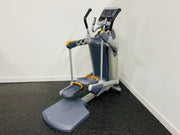
The Life Fitness Arc Trainer 3-in-1 Cross Tainer is a lower-body cardio machine with stationary arms. Its foot platforms follow an arc-shaped path, while incline changes create three movement emphases described by Life Fitness as glide, stride, and climb. These are training modes created by the machine’s settings, not three separate machines.
The lower-body configuration emphasizes leg drive and conditioning. It is best treated as a cardio machine rather than a replacement for progressive strength training with weights. Workload can be adjusted through incline, resistance, and pace, making the machine suitable for steady aerobic sessions or controlled intervals.
Muscles Worked
The main muscles involved are the quadriceps, hamstrings, glutes, and calves. Lower incline settings are more glide-oriented, middle settings emphasize stride, and higher settings create a climb-oriented pattern. The exact emphasis also depends on resistance, pace, and how forcefully the user drives through the platforms.
The trunk contributes to posture and stability, but the lower-body version does not provide the same upper-body involvement as an Arc Trainer with moving handles because its arms are stationary.
Arc Trainer Setup and Proper Form
Before starting, confirm that the machine is stable and that the console, resistance, and incline controls respond normally. Hold the stationary grips while stepping onto the foot platforms. Place both feet securely, allow the pedals to settle, and begin at a slow pace.
Choose a low incline and manageable resistance for the first few minutes. The documented configuration associated with this listing has incline levels from 0 to 20, resistance levels from 1 to 100, and a fixed 24-inch stride. Because used Arc Trainers can differ by generation and console, verify the actual unit’s model information on the listing and model plate.
Technique Cues
Stand tall with your head facing forward and shoulders relaxed. Keep the torso controlled rather than folding over the console or hanging heavily on the grips. Press smoothly through the platforms and let the machine guide the arc.
Maintain a pace that allows control through the full movement. If your feet shift, the motion becomes jerky, or you need substantial support from the grips, reduce pace, incline, or resistance. During intervals, make recovery easy enough to restore good technique. Stop if the movement feels unstable or painful.
Exercise Steps
1. Check the machine and step onto the platforms while holding the stationary grips. 2. Position both feet securely and begin slowly. 3. Select a low incline and manageable resistance for warm-up. 4. Build pace gradually while maintaining posture and rhythm. 5. Keep the leg drive smooth without bouncing, twisting, or leaning heavily. 6. Change one main variable at a time to match the session goal. 7. Reduce the workload before stepping off carefully.
Arc Trainer Workouts: Sets, Reps, and Progression
Because this is a cardio machine, time and effort intervals are generally more useful than traditional lifting repetitions. Sets can describe repeated work intervals. Use the following templates as practical starting points, selecting a workload that preserves consistent form.
Beginner Steady-State Session
Warm up for 5 minutes at a low incline and comfortable resistance. Continue for 10 to 20 minutes at a sustainable pace, then cool down for 5 minutes. Begin with one session and add time gradually when the current duration feels controlled. Keep the workload modest while learning the motion.
Beginner Interval Session
After a 5-minute warm-up, complete 4 to 6 rounds of 30 seconds at a stronger but controlled effort followed by 90 seconds of easy movement. Finish with a 5-minute cool-down. Keep the incline consistent at first and change only resistance or pace. The hard intervals should not become uncontrolled sprints.
Appropriate Advanced Progression
An experienced user can try 6 to 10 rounds of 45 to 60 seconds at a high but technically controlled effort, followed by 60 to 120 seconds of recovery. Another option is a 20- to 30-minute conditioning session using moderate resistance and planned incline changes.
Progress by changing one variable at a time: duration, interval count, incline, resistance, or pace. Do not raise every setting simultaneously. Higher incline and resistance increase the demand, so preserve smooth movement and posture before pursuing a harder workload.
Common Mistakes and Complementary Exercises
A common mistake is using the grips to support too much body weight. This reduces the leg-focused challenge and often produces a rounded posture. Other errors include starting too hard, changing several settings at once, rushing the motion, and treating every session as maximal effort.
Higher incline is not automatically better. Use lower settings for glide-oriented, longer aerobic work, moderate settings for stride-oriented conditioning, and higher settings for shorter climb-oriented efforts when technique remains controlled.
Build a Balanced Program
Pair Arc Trainer sessions with complementary lower-body exercises such as squats, split squats, hip hinges, step-ups, and calf raises when appropriate for the individual. These movements provide patterns that differ from continuous Arc Trainer motion. Upper-body pushing and pulling exercises can address the limited upper-body involvement of stationary grips.
A practical structure may include one steady Arc Trainer session, one interval session, and separate full-body strength sessions with recovery between demanding lower-body workouts. The machine should support the wider program rather than replace every other training method.
Safety and Inspecting a Used Life Fitness Arc Trainer
Keep the area around the machine clear, use the grips when mounting and dismounting, and exercise only when the motion is smooth and controls behave as expected. Match workload to experience and stop if movement becomes jerky, unstable, or painful. This is general exercise guidance, not medical advice.
General specifications for the documented configuration include a 400-pound maximum user weight, 412-pound product weight, and 0 to 900-watt resistance range. They do not establish the condition of an individual pre-owned unit. On the current product listing, confirm the serial or model plate, console, power requirements, incline, resistance, display, controls, foot platforms, grips, linkages, and smooth operation. Ask for service or operating information when it is not shown.
Do not assume that the EL5 identifier confirms the factory generation, console, electrical configuration, operating hours, warranty, or mechanical condition. The current product listing remains authoritative for the actual used item, including its condition and included components.
Frequently asked questions
What muscles does the Life Fitness Arc Trainer work?
It primarily works the quadriceps, hamstrings, glutes, and calves, while the trunk helps maintain posture. Its lower-body version has stationary arms.
Is the Arc Trainer an elliptical?
It is a distinct cardio machine with an arc-shaped foot path and glide-, stride-, and climb-oriented emphases created through incline changes.
How long should a beginner use the Arc Trainer?
Start with a 5-minute warm-up, 10 to 20 minutes of controlled work, and a 5-minute cool-down. Increase duration gradually.
What is a good Arc Trainer interval workout?
Try 4 to 6 rounds of 30 seconds at a strong controlled effort and 90 seconds easy, after warming up, then cool down.
Should I hold the handles while using the Arc Trainer?
Use stationary grips for balance and mounting or dismounting, but avoid leaning heavily on them. Keep the torso controlled and let the legs drive.
What should I check on a used Life Fitness Arc Trainer?
Confirm the model plate, console, power requirements, incline, resistance, display, controls, platforms, grips, and smooth operation. The listing governs the actual unit’s condition.
Explore Uplift Equipment

Life Fitness Arc Trainer 3-in-1 Cross Tainer (EL5)
See this equipment’s current price, condition and availability.
View Life Fitness Arc Trainer 3-in-1 Cross Tainer (EL5) and check current availability.
Life Fitness Arc Trainer 3-in-1 Cross Trainer: Commercial Benefits and Buying Guide
Life Fitness Arc Trainer 3-in-1 Cross Tainer (EL5): Commercial Buying Guide