



What Is the Star Trac 8RDE Cross Trainer?
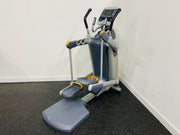
The Star Trac 8RDE is a commercial rear-drive elliptical designed for continuous lower- and upper-body movement. Manufacturer materials identify it as the 8RDE Rear Drive Elliptical, while Uplift uses the title Star Trac 8-Series Series Rear Drive Cross Trainer. The supplied product information identifies the listed unit as an LED-console version, but the current listing remains authoritative for that used machine’s condition and included equipment.
Published specifications do not agree on every detail. The manufacturer identifies an 18-inch stride and alternator resistance, while the Uplift description states 25 inches and electromagnetic resistance. Dimensions and the 350-pound maximum user weight are consistent. Confirm the nameplate, console, stride and resistance details before purchasing or planning a facility layout.
For training, treat the 8RDE as a standing elliptical: the pedals follow an oval path, and actively using the moving arms adds upper-body involvement. The exact condition of a used unit must be inspected, not assumed.
Muscles Worked on the Star Trac 8RDE
Elliptical exercise primarily uses the quadriceps, hamstrings, glutes and calves. The quadriceps help extend the knee as you drive the pedals, while the hamstrings and glutes contribute to hip extension and control. The calves assist with ankle movement and foot pressure.
Using the moving handles adds pushing and pulling for the arms, shoulders, chest and upper back. This does not make the machine a strength-training station, but it can create more full-body movement than holding stationary handrails. Fixed rails are useful when balance is uncertain.
Resistance changes how challenging the movement feels, while cadence changes pedal speed. For general conditioning, choose a level that permits controlled, continuous motion rather than assuming the highest setting is best.
Forward and Reverse Movement
Forward pedaling is the simplest option for learning the machine. If the installed configuration supports reverse movement, try it only after forward technique is comfortable and begin with low resistance. Keep reverse movement slow and controlled.
Setup and Proper Form
Before mounting, inspect the unit for worn, loose or damaged components. Wear athletic shoes, avoid loose clothing and understand the emergency-stop procedure. Use the handrails while mounting and dismounting, and wait until the pedals have completely stopped before stepping off.
Place both feet securely in the pedals and stand tall without locking the knees. Keep the hips facing forward, shoulders relaxed and head neutral. Let the pedals travel smoothly rather than stomping or bouncing. Keep your feet centered and use light, controlled contact with the handles.
Begin at a pace that allows stable posture and repeatable technique. Avoid letting the knees collapse inward. If you need to lean heavily on the rails, reduce resistance or cadence. Guide the moving arms instead of yanking them with the shoulders.
Use the LED console for available workout feedback and make deliberate changes. Contact heart-rate grips and an optional wireless chest strap are listed features, but monitoring functions and accessories should be confirmed on the individual used unit.
A Simple Exercise Sequence
Mount with the pedals stopped and hold the handrails. Start at an easy pace and low resistance, then settle into a smooth forward rhythm. Keep the torso upright and use the handles only as much as you can control. Reduce pace before stopping, wait for the pedals to stop completely, then dismount using the handrails.
This is a technique template, not a replacement for the machine manual or individual coaching. Facilities should also teach users how to operate the emergency stop and keep surrounding space clear.
Sets, Reps and Workout Ideas
Elliptical training is usually programmed by time, resistance and cadence rather than traditional repetitions. A beginner can start with 10 to 20 minutes of easy, continuous movement two or three times per week. Use a level that permits stable posture, and add time gradually only when technique remains consistent.
A practical steady-state session is five minutes easy, 15 to 25 minutes at a repeatable effort, then five minutes easy. For intervals, alternate one minute at a moderately challenging resistance with two minutes easy for four to six rounds. These are general examples, not Star Trac factory prescriptions.
More experienced users can perform three to five work intervals of three to five minutes, separated by two to three minutes of easier movement. Progress one variable at a time: duration, resistance or interval count. Stop increasing resistance when posture, foot position or arm coordination deteriorates.
The manual documents Quick Start, Manual, Auto Pilot, Warm Up, Random Hill, Alpine Pass, heart-rate training and fitness testing. Its Warm Up program is described as seven minutes with three resistance settings. Verify program names and functions on the installed console.
Beginners should prioritize mounting, dismounting, posture, smooth pedal travel and console familiarity. Advanced users may manipulate resistance and intervals or place the elliptical in a broader conditioning circuit, but complexity should not replace controlled movement.
Common Mistakes to Avoid
Leaning heavily on the handrails can encourage rounded posture and reduce the need to stabilize the torso. Stand tall and use only the support needed for balance.
Choosing excessive resistance too soon is another common error. If the pedals become jerky, the knees drift inward or the arms are pulled aggressively, lower the level and restore a smooth rhythm. Chasing speed can create the same problem.
Never mount or dismount while the pedals are moving. Avoid loose clothing that could catch on moving components. Stop exercising if you experience chest pain, unusual shortness of breath, dizziness, faintness or other abnormal symptoms, and follow the owner’s manual when suitability is uncertain.
A clean used machine is not proof of verified mechanical condition. Inspect pedal tracks, moving arms, bearings, console operation, resistance changes, emergency stop and any unusual noise or looseness. Request serial or nameplate information when published specifications conflict.
Complementary Exercises and Safety Planning
The 8RDE can serve as the conditioning portion of a balanced commercial fitness session. Pair it with controlled squats or split squats for lower-body strength, pushing exercises for the chest and shoulders, pulling exercises for the upper back, and trunk-control work. Keep strength-training technique separate from fatigued, high-effort intervals when coaching beginners.
A simple session might include a short elliptical warm-up, two or three strength movements with controlled repetitions, and an easy elliptical finish. The machine can also be used between strength stations when the goal is general conditioning rather than maximal lifting performance.
Before every session, confirm that the unit is stable, pedals and arms move normally, the console responds and no components appear damaged. Stay within the model’s published 350-pound maximum user weight. For pre-owned equipment, verify the current listing’s actual condition, service history, included components and coverage rather than relying on general model specifications.
Frequently asked questions
What muscles does the Star Trac 8RDE work?
It primarily works the quadriceps, hamstrings, glutes and calves; active moving-handle use also involves the arms, shoulders, chest and upper back.
What is the correct way to use the Star Trac 8RDE?
Inspect it first, mount with stopped pedals, stand upright, keep feet centered and move smoothly. Slow down before stopping, then wait for complete pedal stoppage before dismounting.
How long should a beginner use this cross trainer?
Start with 10 to 20 minutes at an easy, repeatable effort two or three times weekly. Increase duration gradually when posture and movement remain consistent.
Does the 8RDE have an 18-inch or 25-inch stride?
Manufacturer sources identify 18 inches, while the Uplift listing states 25 inches. Verify the individual machine’s nameplate and documentation before purchase or programming.
What should I inspect on a used Star Trac 8RDE?
Check the nameplate, console, pedal tracks, arms, resistance, heart-rate grips, emergency stop, fasteners, noise and looseness. Request service history and confirm included accessories.
Can advanced users perform intervals on the 8RDE?
Yes, if controlled posture and pedal motion are maintained. Change one variable at a time and reduce resistance or stop when technique deteriorates.
Explore Uplift Equipment

Star Trac 8-Series Series Rear Drive Cross Trainer
See this equipment’s current price, condition and availability.
View Star Trac 8-Series Series Rear Drive Cross Trainer and check current availability.
Star Trac 8RDE Cross Trainer: Features, Training Uses and Buying Guide
Star Trac 8RDE Cross Trainer: Benefits, Uses and Buying Considerations