



Precor EFX 5.33 overview
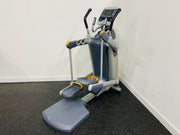
The Precor EFX 5.33 is an older EFX elliptical fitness crosstrainer designed for residential or home use. It combines moving handlebars with mechanically linked pedals, allowing the user to train the lower body or add an upper-body component while exercising. The model is not a current commercial-club EFX design, so facility buyers should assess expected traffic, duty cycle and service support rather than assuming that the Precor name alone establishes commercial suitability.
The Uplift listing identifies this machine as a pre-owned Precor EFX 5.33. General model information should be separated from the condition of the specific used unit: the listing remains the authority for the exact machine, while manufacturer literature helps explain the model’s original design and specifications.
Verified model specifications
The matching Precor literature identifies an 80-inch length, 32-inch width, 64-inch height, 197-pound machine weight and 19-inch stride length. The brochure documents resistance levels from 1 through 20, a powder-coated steel frame, 120 VAC power and 14 workout programs. The Uplift listing agrees with the length, width, height, machine weight and stride figures.
The listing gives a maximum user weight of 300 pounds, but the research materials did not independently confirm that figure as a matching Precor specification. Treat it as a seller-provided listing detail and verify it before placing the machine into a facility or prescribing it to a particular user.
How the EFX 5.33 works
The machine uses a coordinated pedal and handlebar motion. Precor’s owner’s information describes the handlebars as providing an upper-body component, while the resistance setting applies to both the lower- and upper-body mechanisms. This makes the EFX useful for steady aerobic sessions, interval-style work and cross-training formats that alternate effort without requiring impact-based running.
The console’s original program set includes Manual, Hill Climb, Random, Weight Loss, Interval, Heart Rate, Fitness Test, Custom, Calories Goal, Distance Goal and crosstraining-related programs, for 14 programs in the brochure. The console is a basic, non-connected design rather than a modern connected training platform, so operators should plan coaching and workout tracking accordingly.
Ramp and resistance considerations
The CrossRamp specification requires particular care. Uplift’s listing describes a 15- to 30-degree adjustable incline, while the matching Precor brochure identifies a fixed 20-degree CrossRamp. The owner’s manual also describes a fixed incline, although one section gives a different angle, creating an inconsistency within the available Precor documentation.
Do not assume that the used machine has an adjustable ramp. Ask for a demonstration or a photo or video of the exact ramp mechanism before treating incline adjustment as an established feature. The 20 resistance levels are documented in the model literature, but the actual unit should still be tested through its full range.
Power and drive terminology
The listing describes a rear-drive, self-powered system, but the machine also requires a grounded 120-volt AC outlet. Therefore, self-powered should not be interpreted as electrically independent or battery-free. Confirm the power cord, grounded plug and outlet requirements for the exact unit before planning installation.
Training applications and suitable users
A sensible first session begins with the stationary handrail and pedals. Once the user is comfortable with the motion, the moving handlebars can be introduced. Start with a short Manual session at low resistance, focusing on smooth pedal travel, stable posture and controlled effort. Increase either duration or resistance gradually rather than changing both at once.
For general gym programming, Manual mode suits warm-ups and steady aerobic work. Interval and Hill Climb programs can provide structured changes in effort, while Heart Rate and Fitness Test options may suit users who want more guided sessions. Wireless heart-rate features require a compatible chest strap, and the touch sensors should be considered an additional console feature rather than a substitute for a user’s preferred monitoring method.
Safety and operating routine
The owner’s manual recommends using the stationary handrail when stepping on or off, removing the locking pin before exercise and reinserting it when the machine is finished or unattended. It also describes allowing the automatic five-minute cool-down to run. These procedures matter in shared spaces because they reduce avoidable handling and help staff establish a consistent orientation routine.
Users should follow the machine’s instructions and obtain appropriate professional guidance if they have a medical condition, pain or uncertainty about exercise intensity. The 19-inch stride and fixed-ramp question should be considered when matching the machine to different users, especially when several people will share it.
Using a pre-owned EFX 5.33 in a commercial setting
Because the EFX 5.33 is documented as a household-use model, it should not automatically be positioned as a replacement for a commercial-club elliptical. It may be considered for a controlled, lower-volume environment only after the operator evaluates expected usage, supervision, electrical setup, service access and the consequences of downtime. A busy facility should compare those factors with equipment specifically documented for commercial use.
For a studio, private training space or small office gym, the machine’s dimensions and 197-pound weight are important planning inputs. Allow clearance for access, confirm the 120-volt outlet location and measure the route through doors and stairs before delivery. The 80-by-32-by-64-inch footprint is a general model specification; the current unit’s packaging and transport requirements may differ.
What staff should confirm before deployment
Test that the console powers up consistently, the display buttons respond and the programs and workout summary operate. Run every resistance level, check that the pedals and rollers move smoothly and listen for clicking, grinding, binding, belt noise or side-to-side play. Confirm that both moving handlebars are synchronized and that the locking pin is present and secures the roller arm.
If heart-rate monitoring matters to the facility, test the touch sensors and confirm whether wireless telemetry works with the intended chest strap. Record the exact serial number, power-cord status and any available service history. These checks describe what to inspect; they do not promise the condition of any particular used unit.
Pre-owned buying and maintenance checklist
Ask the seller to clarify the exact CrossRamp configuration, user-weight information, serial number, service history and any parts replaced. Also request confirmation of visible damage, including cracked plastic, damaged rails, bent arms, loose hardware or worn rollers. The product listing should be reviewed directly for the current unit’s condition details, because general EFX 5.33 specifications cannot establish hours, refurbishment work, warranty coverage or component condition.
Routine care described in the owner’s manual includes cleaning exposed rails and roller wheels, keeping pedal grooves clean and vacuuming beneath the machine. Do not spray liquid onto the console or machine. The manual states that the unit has no user-serviceable parts requiring lubrication, so operators should avoid adding lubricants unless directed by appropriate service documentation.
When professional service is appropriate
The service manual warns that servicing involves high-voltage components and moving machinery and is intended for trained service providers. Internal troubleshooting is therefore not a casual maintenance task. For a facility, establish who will inspect or repair the unit before purchase, and keep the machine out of service if a safety-critical fault, damaged cord, unstable frame or abnormal movement is found.
Bottom line for buyers
The Precor EFX 5.33 offers a 19-inch stride, moving handlebars, 20 documented resistance levels and a selection of established workout programs. Its most important buying uncertainty is the ramp: seller information describes adjustment, while Precor documentation describes a fixed design with inconsistent angle references. Verify that feature, test the actual machine and treat its household-use designation seriously before selecting it for commercial traffic.
Frequently asked questions
Is the Precor EFX 5.33 a commercial elliptical?
No. The available Precor documentation identifies the EFX 5.33 as intended for household use. A facility should evaluate volume, supervision, service support and downtime risk rather than assume it has commercial-club durability.
What is the Precor EFX 5.33 stride length?
The model literature and listing identify a 19-inch stride length.
Does the EFX 5.33 have an adjustable incline?
This is not confirmed. Uplift’s listing describes a 15- to 30-degree adjustable CrossRamp, while Precor documents describe a fixed ramp. Ask to see the exact unit operate before relying on incline adjustment.
How many resistance levels does it have?
Precor’s model information documents resistance levels 1 through 20. The actual pre-owned machine should be tested through all levels before purchase or deployment.
What should I inspect on a used EFX 5.33?
Check console operation, resistance changes, smooth pedal and roller movement, synchronized handlebars, the locking pin, heart-rate features, power cord, rails, frame, hardware, belt noise and service history. Confirm the serial number and exact condition on the current listing.
Explore Uplift Equipment

View Precor EFX 5.33 Elliptical and check current availability.
Precor EFX 5.33 Elliptical: Benefits, Use and Buying Guide
Precor EFX 5.33 Elliptical Workout Guide: Muscles, Form, and Training Tips