
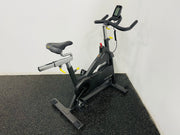



What Is the FreeMotion S11.9 Chain Drive Indoor Cycle?
The FreeMotion S11.9 Chain Drive Indoor Cycle is a commercial-style indoor cycling bike designed for studios, fitness centers, and performance training environments. This version uses a chain drive, magnetic eddy-current resistance, and a perimeter-weighted cast-iron flywheel. It is important not to confuse it with the separate S11.9 Carbon Drive model, which uses a belt rather than a chain.
The listed model specifications include dimensions of 50 inches long by 20.1 inches wide by 39 inches high, a machine weight of 125 pounds, and a stated maximum user weight of 350 pounds. These are general model or listing specifications, not a guarantee about the condition of any particular pre-owned unit.
Chain drive and magnetic resistance
The chain drive connects the pedals and flywheel through a mechanical drivetrain. Compared with the Carbon Drive version, the chain-drive design may produce more mechanical noise, so sound level can matter when planning a studio or shared training space.
Magnetic eddy-current resistance changes the training load without relying on a friction pad pressing directly against the flywheel. The resistance knob also incorporates a quick-stop function, while the manual identifies the bike as a non-freewheel design: the pedals continue moving while the flywheel is rotating.
Training Benefits for Indoor Cycling
The S11.9 is suited to steady aerobic riding, interval sessions, higher-resistance seated climbing work, and general cycling conditioning. Its perimeter-weighted flywheel is designed to provide high inertia, which can create a stable, continuous pedaling feel during sustained efforts and changes in resistance.
Magnetic resistance gives instructors or individual users a direct way to adjust effort during warm-ups, intervals, endurance rides, and recovery periods. Riders can build sessions around cadence, perceived exertion, or resistance rather than relying on a fixed workout format.
Indoor cycling is also practical when outdoor riding is affected by weather, traffic, or limited daylight. For general health, the CDC recommends that adults accumulate at least 150 minutes of moderate-intensity aerobic activity or 75 minutes of vigorous activity each week, along with muscle-strengthening activity on at least two days. The bike can support the aerobic portion, but it does not replace strength training.
A practical way to use the bike
A new user can begin with a low-resistance warm-up, then alternate manageable work periods with easier recovery riding. Moderate intensity generally allows conversation but not singing, while vigorous intensity allows only a few words at a time. Users should choose an effort appropriate to their fitness and follow professional medical advice when needed.
Correct setup is essential. The manual recommends positioning the saddle so the knee retains a slight bend when the pedal is at its lowest point. Seat and handlebar adjustments should be locked securely before riding.
Design Advantages for Different Riders
The S11.9 provides fore-and-aft adjustment for both the seat and handlebars, helping accommodate riders with different body dimensions and riding preferences. This is particularly useful in a facility where equipment is shared between members or where instructors need repeatable setup positions.
The dual-sided pedals combine SPD clip compatibility with toe cages, allowing riders to use compatible cycling shoes or standard athletic footwear. Before a class or training session, staff should check that the pedal hardware and toe cages are present and secure on the specific bike.
The listed self-powered system uses an alternator and battery, eliminating the need for an external power cord. That can simplify placement within a facility, although the condition and operation of the battery, alternator, and any electronics must be confirmed on the individual used unit.
Space and placement considerations
The listed footprint is 50 by 20.1 inches, but buyers should allow additional clearance for access, rider movement, cleaning, and service. The user manual recommends a level surface, a mat, and approximately two feet of clearance. Confirm the installation area and delivery route before purchasing, particularly in a commercial facility or upper-floor training room.
Why Consider Pre-Owned Commercial Fitness Equipment?
Pre-owned commercial equipment can help a gym, studio, apartment fitness room, or home facility obtain established commercial designs without specifying an entirely new equipment package. A used indoor cycle may also be useful when a facility needs to expand a room gradually or replace one matching unit rather than redesigning the whole space.
The practical value depends on inspection, included components, service history, and the seller’s written terms. A model’s original specifications do not establish the condition of the individual bike being shipped. The current product listing remains authoritative if a replacement unit is returned or supplied.
For this S11.9, ask for confirmation of the serial or model label, including whether it identifies a compatible chain-drive version. Request details about console inclusion, electrical operation, pedal hardware, adjustment mechanisms, and any stated warranty or return terms before committing to the purchase.
Inspection checklist for the current unit
Inspect or request evidence of smooth resistance adjustment, quick-stop brake operation, and consistent pedaling. Listen for chain skipping, grinding, tight spots, or abnormal noise. Check crank and bottom-bracket play, pedal condition, SPD mechanisms, toe cages, saddle hardware, handlebar sliders, adjustment pins, and locking knobs.
Also check the frame for corrosion or damage and confirm the exact frame material. Research identified conflicting descriptions: the Uplift listing describes a zinc-plated steel frame, while an archival FreeMotion specification sheet describes an aluminum frame for an S11.9 reference. Treat the frame material as unconfirmed unless the serial label or inspection resolves the discrepancy.
Who Is the FreeMotion S11.9 Best Suited To?
This cycle is a potential fit for commercial gyms, cycling studios, personal training facilities, performance spaces, and experienced home users who want a studio-style riding position and adjustable magnetic resistance. Its dual-sided pedals can support mixed-use facilities where not every rider owns cycling shoes.
It may also suit facilities that need a non-freewheel indoor cycle for structured intervals, endurance work, and seated resistance training. A 350-pound stated maximum user weight provides a specification for planning, but users and operators should follow the manufacturer’s safety guidance and verify the current unit’s condition.
The bike may be less suitable where exceptionally quiet operation is a priority, because the chain drivetrain can be noisier than the Carbon Drive alternative. It may also be a poor choice for buyers who require guaranteed console functionality, documented service history, or a particular frame material unless those details are confirmed for the specific listing.
Limitations and Final Buying Guidance
The most important limitation is that general model specifications cannot predict the condition of a pre-owned machine. Chain wear, lubrication history, bearings, pedals, adjustment hardware, battery, alternator, console, and emergency-stop operation may vary between units. Do not treat a listing’s general description as a promise that every component is present or fully operational.
The S11.9 is also a non-freewheel bike, so the pedals continue moving with the flywheel. Riders should learn the resistance and quick-stop controls before performing hard efforts. The manual advises regular inspection and tightening of parts and prompt replacement of worn components.
Overall, the model offers a high-inertia ride, magnetic resistance, broad rider adjustment, dual-sided pedals, and cordless operation as listed. The purchase decision should rest on inspection results, confirmed accessories, delivery requirements, written terms, and the condition of the exact unit—not on the original commercial specification alone.
Frequently asked questions
Is the FreeMotion S11.9 a chain-drive or Carbon Drive bike?
The product discussed here is the chain-drive version. FreeMotion also produced an S11.9 Carbon Drive model, so buyers should verify the serial or model label and inspect the drivetrain before purchase.
What types of workouts can be performed on this indoor cycle?
It can support steady aerobic riding, interval training, higher-resistance seated climbing work, and general cycling conditioning. Users should adjust intensity progressively and use the resistance and quick-stop controls correctly.
Does the FreeMotion S11.9 require an external power cord?
The listing describes the model as self-powered through an alternator and battery. The condition and operation of those components, along with any console, must be confirmed for the individual pre-owned unit.
Can different riders use the same bike?
Yes, the model includes fore-and-aft seat and handlebar adjustments, which can help accommodate multiple riders. Each user should confirm that the adjustment mechanisms lock securely before riding.
What should I inspect on a pre-owned S11.9?
Check the chain, crank and bottom bracket, pedals, toe cages, SPD mechanisms, saddle, adjustment hardware, resistance control, quick-stop brake, battery, alternator, console, frame, and signs of corrosion. Ask the seller to confirm included accessories and written terms.
Is the frame material confirmed?
Not conclusively. The supplied listing describes zinc-plated steel, while an archival specification describes aluminum for an S11.9 reference. Confirm the material on the specific unit through its label or a close inspection.
Explore Uplift Equipment

Freemotion S11.9 Chain Drive Indoor Cycle
See this equipment’s current price, condition and availability.
View Freemotion S11.9 Chain Drive Indoor Cycle and check current availability.
FreeMotion S11.9 Chain Drive Indoor Cycle: Commercial Buying and Training Guide
FreeMotion S11.9 Indoor Cycle Training Guide: Setup, Form, and Workouts