
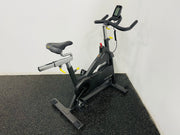



FreeMotion S11.9 Chain Drive Indoor Cycle Overview
The FreeMotion S11.9 Chain Drive Indoor Cycle is a studio-style commercial bike intended for aerobic riding, intervals and cycling conditioning. Its defining systems are a chain drive, magnetic eddy-current resistance and a perimeter-weighted cast-iron flywheel. These are general model specifications; the current listing remains authoritative for the condition and contents of any particular pre-owned unit.
This version should not be confused with the FreeMotion S11.9 Carbon Drive model. The drivetrains are different, so belt-drive maintenance information should not automatically be applied. The chain-drive manual identifies model FMEX82910.0, which can help verify the advertised version.
Verified model specifications
Listed dimensions are 50 inches long by 20.1 inches wide by 39 inches high, with a listed machine weight of 125 pounds and stated maximum user weight of 350 pounds. The product information also identifies dual-sided SPD and toe-cage pedals, a 7-pound aluminum handlebar, fore-and-aft seat and handlebar adjustment, and an integrated quick-stop function.
The bike is described as self-powered through an alternator and battery, rather than requiring an external power cord. These specifications describe the model, not proof that every electrical or mechanical component works on a used unit.
How the Drive, Flywheel and Resistance Work
The chain transfers pedaling force to the flywheel. This is a non-freewheel indoor cycle: while the flywheel rotates, the pedals continue moving. Riders should control cadence and learn the resistance and stopping procedure before attempting hard efforts.
The perimeter-weighted cast-iron flywheel is specified as high inertia, supporting continuous pedaling, cadence changes and resistance-based work. Actual feel depends on the individual bike’s chain, bearings, pedals and other wear points, so a test ride is important when evaluating pre-owned equipment.
Magnetic resistance and stopping control
Magnetic eddy-current resistance changes workload without relying on a conventional friction brake pad. The resistance knob can be used for warm-ups, steady riding, intervals and seated climbing. The manual states that pressing the control downward stops the flywheel.
Before putting a used bike into service, test resistance across its range and verify the quick-stop function. A general model description cannot confirm the operating condition of either feature on a specific unit.
Adjustability and User Fit
The seat and handlebars are described as adjustable vertically and fore and aft. That flexibility is useful when members, clients or class participants share equipment. Staff can record each rider’s preferred settings to make repeated setups more efficient.
The manual recommends setting seat height so the knee retains a slight bend when the pedal is at its lowest point. Riders should also adjust reach for controlled, comfortable posture. Fit is a setup responsibility and does not replace coaching or medical advice.
Pedal compatibility
Dual-sided pedals with SPD clips and toe cages accommodate compatible cycling shoes and standard athletic footwear. On a used unit, inspect pedal bodies, cage straps and SPD mechanisms because the general specification does not confirm that every accessory is present or unworn.
Training Applications in a Commercial Gym
The S11.9 can support steady aerobic rides, interval sessions, higher-resistance seated climbing and general cycling conditioning. Instructors can use the resistance knob to organize work and recovery periods, while facilities can position the bike as a cardio station or alongside strength equipment.
The CDC recommends adults accumulate at least 150 minutes of moderate-intensity aerobic activity or 75 minutes of vigorous activity weekly, plus muscle-strengthening activity on at least two days. The talk test provides a practical guide: moderate effort generally permits conversation but not singing; vigorous effort permits only a few words.
A basic session can include an easy warm-up, repeated resistance or cadence efforts, controlled recovery and a gradual cool-down. Intensity should match experience, goals and health status. Operators should teach setup and encourage users to stop for unusual pain, dizziness or other concerning symptoms.
Who is it suited to?
The stated 350-pound maximum user weight may suit many adult users, independent exercisers, coached clients, cycling classes and performance-conditioning environments when their needs are compatible with the equipment. New riders should learn the non-freewheel drivetrain, resistance control and quick-stop procedure before demanding intervals.
Planning a Commercial Installation
The listed footprint is 50 by 20.1 inches, with a height of 39 inches. Facility planners should allow access for mounting and dismounting, instructor visibility and cleaning. The manual recommends a level surface, a mat and approximately 2 feet of clearance around the machine.
Because the system is described as self-powered and cordless, placement is not tied to a wall outlet. Confirm how the alternator and battery relate to onboard electronics, and whether a console is included with the specific used bike before assigning it to a technology-dependent program.
Routine checks should cover pedal security, crank movement, chain sound, resistance response, stopping control, adjustment locks and visible corrosion. The manual advises regular inspection and tightening, with worn parts replaced promptly.
Noise and maintenance expectations
A chain drivetrain can produce more mechanical noise than the Carbon Drive version, according to the cited indoor-cycling equipment review. This matters in quiet studios or facilities running several bikes. Listen to the actual machine rather than assuming every unit sounds alike.
Magnetic resistance may reduce reliance on friction brake-pad maintenance, but it does not remove inspection needs. Chain wear and lubrication, crank or bottom-bracket play, pedals and electrical components remain individual-unit questions.
Buying a Pre-Owned S11.9: What to Verify
The current listing identifies a pre-owned unit and provides general specifications, but those specifications do not promise the condition of the bike shipped. Ask for the serial or model label and confirm that the machine is chain drive rather than the Carbon Drive variant.
Request confirmation of console inclusion if it matters to your program. Ask for inspection notes or a test video showing resistance adjustment, quick-stop operation, pedaling, chain behavior and adjustment hardware. Check for skipping, grinding, tight spots or crank and bottom-bracket play.
Inspect the seat, handlebar sliders, locking pins, pedals, SPD mechanisms and toe cages. Research also found conflicting frame descriptions: the Uplift listing describes zinc-plated steel, while archival FMEX82910 documentation identifies aluminum. Treat frame material as unconfirmed unless the machine or documentation resolves the discrepancy.
Finally, confirm written warranty, return terms, shipping method and whether the stated used condition applies to the exact unit supplied. Do not infer maintenance history, accessories or electrical condition from the model name. If a replacement unit returns, its listing is authoritative.
A practical inspection checklist
Verify the model identifier, chain drivetrain and user-capacity requirement. Test the full resistance range and emergency stop. Check chain noise, crank and bearing play, pedals, adjustment locks, corrosion and any console. Confirm battery and alternator operation where electronics are included, then obtain the seller’s written terms for the specific unit.
Frequently asked questions
Is the FreeMotion S11.9 chain drive the same as the Carbon Drive model?
No. They use different drivetrains. Verify the model label and inspect the drivetrain before buying a pre-owned bike.
What is the stated maximum user weight?
The verified listing specification states a maximum user weight of 350 pounds.
Does the bike require an external power cord?
It is described as self-powered through an alternator and battery, but inspect the used unit’s electrical system.
Can different riders adjust the bike easily?
The model has vertical and fore-and-aft seat and handlebar adjustment. Test the locks and sliders on the actual unit.
What should I check on a used S11.9?
Confirm the drivetrain, test resistance and quick-stop operation, inspect chain, crank, pedals and adjustment hardware, and verify accessories and seller terms.
Is the frame steel or aluminum?
Documentation conflicts. The listing says zinc-plated steel, while archival FMEX82910 material says aluminum; verify the actual bike.
Explore Uplift Equipment

Freemotion S11.9 Chain Drive Indoor Cycle
See this equipment’s current price, condition and availability.
View Freemotion S11.9 Chain Drive Indoor Cycle and check current availability.
FreeMotion S11.9 Chain Drive Indoor Cycle: Benefits, Uses and Buying Considerations
FreeMotion S11.9 Indoor Cycle Training Guide: Setup, Form, and Workouts