



What the Cascade Pro Bike Trains
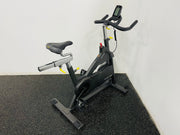
The Cascade Pro Bike is an indoor cycling machine suited to steady cardio, conditioning, and interval work. Pedaling mainly trains the quadriceps, hamstrings, glutes, and calves. Your trunk and upper body contribute to stability while you hold the handlebars, but this is primarily a lower-body conditioning tool rather than a complete strength-training machine.
Research identifies the standard Cascade Pro as likely corresponding to the Cascade Health & Fitness CMXPro indoor group cycle. Published model specifications list a 42-inch length, 23-inch width, 42-inch height, 96-pound machine weight, and 350-pound maximum user weight. These are general model facts, not guarantees about a particular pre-owned unit. Check the current listing, photos, and model identification before use.
How resistance changes the workout
The documented standard model uses non-contact magnetic resistance and a reinforced Poly-V belt drive. Increasing resistance makes each pedal revolution more demanding, while increasing cadence raises movement speed. Begin with a manageable setting that allows smooth pedaling. During intervals, change one main variable at a time so you can evaluate the effect of speed or resistance.
Set Up the Bike Before You Ride
Place the bike on a stable, level surface with clearance around it. Adjust it before exercising and dismount before changing the seat or handlebars. Never make adjustments while the pedals or flywheel are moving. Model documentation describes four-way seat and handlebar adjustment, including height and fore-aft changes, so fit the bike to your proportions rather than copying another rider’s settings.
Seat position
Set the seat height so your knee remains slightly bent at the bottom of the pedal stroke. A locked knee can indicate excessive height, while an overly compressed position may indicate a low setting. For fore-and-aft positioning, use the manual’s reference of placing the front-leg tibial tuberosity approximately above the pedal axle. Secure the adjustment, then test slowly. If it does not lock firmly, stop before training.
Handlebars and pedals
Set the handlebars where you can reach them with a slight elbow bend. Keep your shoulders relaxed and confirm that the pedals are tight and the straps are present and secure. The standard model is documented with caged pedals and straps, but inspect the actual used unit for hardware and wear.
This bike does not have a freewheel system, so the pedals continue moving while the flywheel is moving. Keep your feet controlled and wait for both flywheel and pedals to stop before dismounting.
Proper Cascade Pro Bike Form
Begin slowly with at least a five-minute warm-up, as recommended in the owner’s manual. Use light-to-moderate resistance while establishing a smooth rhythm. Keep your hips centered, hands light on the handlebars, elbows softly bent, and torso stable without leaning heavily on the bars.
Pedal continuously without bouncing or forcing the movement. If the cages and straps allow it comfortably, apply smooth pressure throughout the stroke. Increase cadence or resistance gradually, not both at once. If technique deteriorates, reduce the challenge and regain control.
A simple exercise sequence
Start with five minutes of easy pedaling, then ride five to ten minutes at a steady pace that permits consistent technique. For intervals, add short harder efforts followed by easy recovery pedaling. Keep the first session conservative and extend work periods only when form remains controlled. Finish with several easy minutes.
Because this is a cardio machine, use time and effort rather than a fixed repetition prescription. Beginners can start with one or two sessions weekly and build gradually. Experienced riders may use two or three structured sessions, separating demanding rides with easier training or rest.
Beginner and Advanced Training Ideas
Beginners should prioritize setup, cadence control, and consistency. Try five minutes of warm-up, ten minutes of comfortable steady riding, and five minutes of easy pedaling. If that is manageable, add a few minutes to the middle section in later sessions. Keep resistance low enough to follow the manual’s gradual approach to intensity.
Experienced riders can use repeated moderate-to-hard efforts separated by easy pedaling. Another option is a resistance-focused session in which cadence stays controlled while resistance changes in small steps. Advanced training still requires the same fundamentals: adjust the bike while stopped, progress gradually, and stop if unusual noise, instability, or rough movement develops.
Progress without losing technique
Progress one element at a time: total riding time, cadence, resistance, or interval count. Record the setting or perceived effort so sessions can be compared. A maximum user-weight rating or published construction detail does not replace fit, equipment inspection, or personal limitations.
The standard model specifications do not establish a console, watt display, Bluetooth connection, or performance-data system. Do not plan around those features unless the current listing and actual machine confirm them.
Common Mistakes and Safety Checks
Riding with the seat too high can encourage reaching at the bottom of the stroke. Handlebars that are too low or far away may cause excessive weight-bearing through the arms. Avoid a tight grip, rocking hips, and abrupt resistance changes used to compensate for poor positioning.
Do not try to stop the bike by pushing backward against the pedals. Dismount only after the flywheel and pedals stop. Do not use the bike if it rocks or has loose pedals, damaged straps, insecure adjustment hardware, or other faults.
Inspecting a pre-owned Cascade Pro Bike
Published specifications describe the general model, not the current used item’s mileage, service history, belt, bearings, cosmetic wear, or prior use. Review the current product listing and inspect the actual unit rather than treating a condition label as a performance guarantee.
Before training, check pedal tightness and straps, crank bolts, belt condition and tension, stabilizer bolts, leveling feet, adjustment mechanisms, and flywheel movement. Clicking or rough flywheel bearings, or play and knocking at the bottom bracket, require attention. The manual says worn or inoperable components should be repaired before use.
Complementary Exercises for a Balanced Program
The Cascade Pro Bike provides lower-body conditioning but does not replace upper-body resistance training or every movement pattern. Pair cycling with controlled exercises involving pushing, pulling, trunk control, and deliberate lower-body strength work. Examples include bodyweight squats, hinges, lunges, rows, presses, and loaded carries when appropriate for the user and facility.
Keep complementary work separate when fatigue could compromise technique. One session might begin with easy cycling, continue with planned strength exercises, and finish with easy pedaling. Alternatively, use the bike for conditioning on cardio days and strength exercises on separate days. Select movements you can perform safely with available equipment and coaching.
Frequently asked questions
What muscles does the Cascade Pro Bike work?
It primarily trains the quadriceps, hamstrings, glutes, and calves. The trunk and upper body help stabilize the rider, but it is mainly a lower-body conditioning machine.
How should I set the Cascade Pro Bike seat height?
Set it so the knee remains slightly bent at the bottom of the stroke. Use fore-and-aft adjustment as a reference, with the front-leg tibial tuberosity approximately above the pedal axle. Adjust while dismounted.
How long should a beginner ride the Cascade Pro Bike?
Start with five minutes of warm-up, about ten minutes of comfortable riding, and several easy minutes to finish. Increase time gradually while maintaining smooth, controlled pedaling.
Can I stop pedaling suddenly on this bike?
Do not push backward against the pedals to stop. Because there is no freewheel system, wait until the flywheel and pedals stop before dismounting.
What should I inspect on a used Cascade Pro Bike?
Check pedals, straps, crank bolts, belt, stabilizer bolts, leveling feet, adjustment hardware, flywheel, bearings, and bottom bracket. Address rocking, clicking, roughness, play, or loose parts before use.
Does every Cascade Pro Bike include a console or watt display?
No such feature is established for the standard model identified in the research. Confirm the exact model and included features on the current listing and actual machine.
Explore Uplift Equipment

View Cascade Pro Bike and check current availability.
Cascade Pro Bike: Commercial Indoor Cycling Features, Uses and Used-Buying Guide
Cascade Pro Bike: Compact Commercial Cardio for Practical Training